Activated Carbon for Air Purification and VOC Removal
Air pollution is a grave concern in 2025, and it’s going to get worse if we don’t take necessary actions. The good news is that governments across the world (especially in Asian countries) are imposing stringent policies on industrial processes. Toxic effluents like VOCs and other pollutants emitted by factories affect the workplace as well as the nearby living spaces of the common people. This imposes health risks over time.
It’s high time that industries, particularly the ones dealing with gaseous chemicals, cleaners and other manufacturing processes, step up their purification game. And this is where activated carbon (AC) shines. Activated carbon air filters happen to be the most eco-friendly and affordable way to filter out the harmful pollutants, that too, at a large scale.
At Suneeta Carbons, we have been manufacturing and exporting high-end activated carbon since 1975, and we understand what it takes to meet the strict regulations. In this blog, we will help you gather the necessary insights regarding the usage of activated carbon in air purification. This will help you to take informed decision before investing in a purifying solution.
What Are VOCs and Why Their Removal Matters
In regions where air quality stays at concerning levels, people don’t realize that they encounter VOCs on a daily basis. You should understand that these are organic chemicals that easily evaporate into the air at room temperature. The source? Well, it’s not generated from a single point, but rather multiple. This includes your industrial solvents, adhesives, paints, fuels, furniture-off gassing, and even household cleaners. In other factories, they stem from chemical processing, printing presses, or storage tanks.
And eliminating them from our ecosystem matters a lot. VOCs generally harm not only the workers at the factories but also people in and around the city. From affecting the lungs to liver damage and other neurological issues, these have been reported by several medical institutions over the last few years. Industries that neglect their emissions violate emission standards like those from the EPA or India’s CPCB, leading to hefty fines.
So, it is high time that every industry sector dealing with harmful effluents prioritizes eliminating VOCs through activated carbon filters. Not only is it an eco-friendly measure, but it also helps maintain a sustainable business. Let’s discuss more about how activated carbon removes VOCs in the next section.
How Activated Carbon Purifies Air
The magic of activated carbon filters is taking the industrial sectors by storm. The reason is its adsorption power. Since it’s a material with unmatched surface area, it traps the harmful VOCs, odors and other unnecessary micro particles in the gaseous emission from the factory setup. If you still want to ideate about its surface area, consider that it easily surpasses that of silica gels or zeolites. Moreover, it neutralizes stubborn smells from smoke or chemicals without electricity or chemicals themselves.
At Suneeta Carbons, we ensure that you get the exact pore structure for your filter, so that your brand meets every stringent regulatory norm out there. Once you start investing in high-quality activated carbon air filters, you will get true purified air without frequent replacement costs and idle times.
Role of Activated Carbon in VOC Removal
When VOCs create havoc in your air, AC steps in with unmatched adsorption capacity, holding 30-50% of its weight in pollutants. It targets a broad spectrum, from benzene to formaldehyde, binding them tightly so they don’t re-release. This makes it ideal for your odor control needs, eliminating factory fumes or pungent indoor smells.
You also benefit from its long service cycle, filters last months or years, depending on load, far outlasting mechanical filters. Our AC products maintain efficiency even in humid conditions, crucial for tropical climates like India’s. Paired with regeneration techniques, you extend usability, optimizing costs.
Types of Activated Carbon Used in Air Filters
High chances that you will get confused while procuring the right activated carbon for your air filtration system at your factory site. Here’s a detailed breakdown for your help:
- Granular Activated Carbon (GAC): Unbound, irregular grains appropriate for loose-fill beds or canisters. Industries use it in high-flow HVAC systems for broad VOC capture due to excellent airflow.
- Pelletized (Extruded) Carbon: Cylindrical pellets minimize pressure drop, ideal for packed towers or ducts. They manage heavy-duty industrial streams with low dust and high mechanical strength.
- Impregnated Carbon: Infused with metals like silver or potassium iodide, it targets specific gases like H2S or mercury vapors. Relevant factory setups incorporate this for corrosive environments or enhanced VOC selectivity.
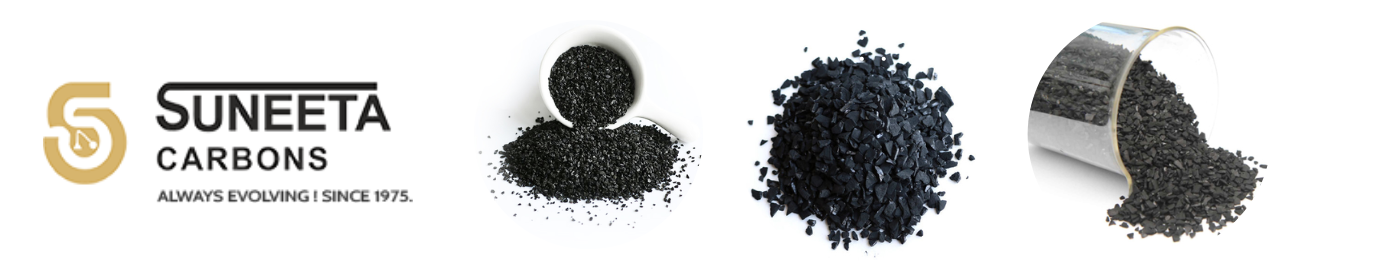
Our expert team at Suneeta Carbons tests the properties of activated carbon at each step. This helps in the seamless categorization of our products as well as in maintaining quality. We obtain GACs through eco-friendly raw materials like wood and coconut shells. This helps brands to maintain that eco-friendly tag if they procure from us.
Industrial Applications
Most decision makers in factory-led industries confuse themselves while procuring the right material for their air purification. And this is the reason why activated carbon is yet to receive the credit it deserves in this domain. Thus, to have the right set of knowledge, more people need to understand the correct industrial applications of activated carbon filters.
For instance-
- In paint booths, it scrubs solvent vapors, letting you recycle air and comply with emissions rules.
- Chemical plants use it to trap leaks from reactors, preventing hazardous buildup.
- For HVAC systems in offices or hospitals, administrations integrate it into filters, slashing indoor VOCs for healthier breathing.
- Industrial exhaust stacks benefit from its capture of fumes, while wastewater plants deploy it for odor control, neutralizing H2S from sewers before it escapes.
- Food processing relies on it to purify process air, too.
While these are some of the common applications in the market now, there are others too. At Suneeta Carbons, we not only help you out in consultation, but you get export-ready solutionsthat scale to your needs. Whether it’s about small vents or massive scrubbers, we’ve got everything you are looking for.
Conclusion
There is no doubt that activated carbon for VOC removal is the ultimate solution for factory sites as of 2025. And it will be so in the years to come as well. It’s not only about the efficiency, but also about its affordability, which is a big catch.
Are you ready to transform your factory emissions into harmless gases? Reach out to us today for the appropriate activated carbon for industrial exhaust or for home needs.
FAQs (Questions Only)
The process involves adsorption. It’s basically the trapping of VOCs in the huge surface area of activated carbon present in the filters when harmful emissions are passed through them.
Yes, activated carbon air filters are used in both indoor and outdoor air purification. These filters trap VOCs, odours, and other gases. It excels in homes when paired with HEPA filters, but needs replacement when saturated.
Pelletized activated carbon is considered to be the best one due to its high porosity, low pressure drops, and efficiency in high flow systems. Whereas GACs excel for heavy VOC air filtration in fixed beds.
Activated carbon in air purification systems typically lasts 3-6 months under normal use, but high-end filters can endure up to 2 years or more. Lifespan shortens with high VOC levels, humidity, or heavy usage.
Yes, activated carbon is widely used in HVAC systems for VOC control via adsorption filters. It effectively reduces indoor VOC levels, often integrated with ventilation for energy efficiency.